
The Simplicity Trap
or: The chasm between "connection" and connection

Probably the greatest policy researcher I’ve ever known was the late Dr. Mark Levitan. He was far more brilliant and accomplished than I could ever hope to be, but was a role model for his fearlessness, creativity, and idea that the work of his life pretty much stayed the same, whether he happened to be operating out of a nonprofit research organization, academia, or municipal government at any given time.1
Mark’s best known achievement was changing how New York City officially measured poverty, but to me he was always the guy who wrote “Out of School, Out of Work… Out of Luck?”, a groundbreaking analysis that raised the issue of “disconnected youth”—young adults who were neither in school nor working—to a place of prominence in New York City that it’s never really yielded.2 Mark pegged the number at 170,000, or roughly the population of Shreveport, Louisiana.
Released in early 2005, just as Mayor Bloomberg was starting his re-election run, the report helped inspire the Commission on Economic Opportunity, which later became the Center for Economic Opportunity,3 and which identified 16-24 year olds as a priority population for program development and investment. It also helped inspire JobsFirst NYC, which has advocated and incubated programs on behalf of high need young adult New Yorkers for 20 years now.
The issue of “disconnected youth” hit the policy sweet spot for me: the intersection of a moral offense (no decent society should shrug at hundreds of thousands of idle young adults, with all the implied despair and wasted potential), an economic hinge (they can add to the tax base, or detract from it), and a system failure (who’s responsible for this mess anyway?).
After reading Mark’s report a bunch of times, I started working on a related project, which really only spoke to the middle of those three issues. My report assessed Boomer retirements and projected workforce demand in 2006, presenting these masses of undirected young New Yorkers as a potential solution to the city’s pending need for nurses, carpenters, auto mechanics, and various other occupations.
I’m deeply embarrassed about this report now, in part for the banality of the analysis but even more for how it blithely regards young people as anonymous economic inputs; more on that below.
I got to take another run at it about fifteen years later, as our office staffed the de Blasio-era Disconnected Youth Task Force from 2019-2021.4 The final DYTF report is a bit easier to take, in that I seem to have figured two things out over the intervening years.
One, it doesn’t use the term “disconnected youth,” with its implied value judgment, but instead describes “out-of-school/out-of-work” young adults (OSOW).5 Two—and now, finally, we’re approaching the point!—it begins to tell the story in a more nuanced way than whether or not a young adult is in school and/or working.
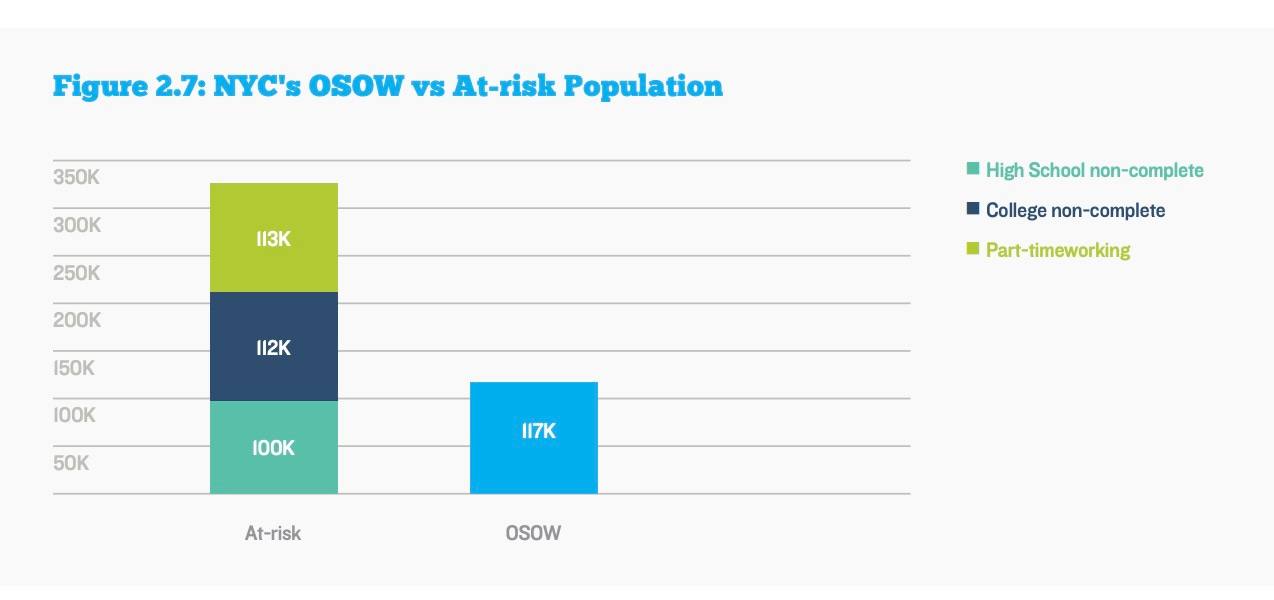
The report includes some pretty solid research on the long-term effects of being OSOW, both on individual life outcomes and community finances. It usefully bursts the myth of OSOW young adults as a bunch of high-school dropouts: by 2018, nearly three-quarters had a high school diploma or equivalency, and one in eight had a bachelor’s degree or higher. It also shows how the number of OSOW young adult New Yorkers had gone up and down over the years, spiking through the Great Recession but steadily declining through the de Blasio years thanks to solid job growth and a rising high school graduation rate.6
In terms of my writing and thinking about the issue, though, the chart above represents the biggest step forward. It suggests that there’s a far larger universe of young adult New Yorkers at risk of becoming OSOW, which is true as far as it goes, and helpful when thinking about the issue from a system level. Indeed, I use the graphic in the narrative of the report to make a point about the importance of prevention strategies.
Where it still falls short, though, is in missing the point that’s obvious when you think about three-dimensional, flesh and blood humans rather than statistics: a young person can remain “connected” and still be in a world of hurt.
Is the point of life to be enrolled in school or employed in a job? Is that all we want for our own friends and loved ones? Of course not! But when it’s other people and their kids—kids who might not look or sound or think like us or our kids, who don’t share our interests and tastes and concerns—it is astonishingly easy to fall into that trap without really thinking about it. To decide that our obligation ends at the point we’re making reasonable efforts to ensure that young people remain “connected.”7
Yesterday I attended an event for an initiative in the city focused on better serving young adults with barriers to education and career success, at which the organizers shared some updates and led breakout group discussion. The final prompt was to share what we hoped to see for young people in NYC within five to seven years’ time. One of my table-mates suggested that the goal of the system should be to support all young people toward first understanding and then making intentional choices to pursue a life path that would make them happy.8
I do think this has to be the core motivation—or at least the single biggest input. What I suspect we really want to solve for is the Venn diagram overlap between “gives me joy” and “pays the bills.” But it has to start with the agency of young people: helping them define themselves as humans and as economic actors, and then making sure they have the tools and supports to define and then pursue their ambitions.9
He was also incredibly kind and supportive to me as a mentor and a friend. We got to do some work together when I consulted for the Community Service Society in the later 2000s, and he was always happy to be a sounding board when I entered and then had a bumpy first few years in city government. But my abiding memory of Mark is actually from after he retired. We went to the same gym on Flatbush Avenue in Brooklyn, and I’d see him there once a month or so, if I went in the afternoon, this guy of nearly 70 at that point, not at all taking it easy and clearly in better shape than me even with the 25 additional years. He seemed exceptionally content, in sharp contrast to the gradations of annoyance he’d usually projected during his working days. As much as I mourned that disease took him many years too soon, I felt and still feel a kind of awe at a life so well and so happily lived.
That was actually Mark’s second legendary report, at least in the eyes of a young think tank researcher. A year earlier, he’d released “A Crisis of Black Male Unemployment,” which I remember John Kerry referencing in one of the 2004 Presidential debates.
And later still, the Office of Economic Opportunity. I think it was still CEO when Mark was there and produced his famous poverty measure.
The Task Force was created and presented as a joint effort of the administration and the City Council. But it proved very difficult to engage the Council at all, and although it wasn’t supposed to be a Center for Youth Employment project, pretty soon we were tasked with it. The report was all but complete in early 2020—and already overdue—and then COVID-19 struck and we had to rewrite large sections so as not to look entirely delusional. This didn’t stop various advocates, including some who had been prominent Task Force members, from beating us up in the press for the delay.
Of course the other famous term is “Opportunity Youth,” which reminds me of being a kid and told to smile in pictures when I wanted to punch whoever had the camera. There’s also NEETs (Not in Education, Employment, or Training), which feels like trying to be clever for the sake of being clever, though I guess it can at least claim brevity as a virtue. I do think language matters—and I hate that the latest Republican workforce reauthorization attempt restores arguably stigmatizing terminology for no evident reason other than trolling. It just doesn’t ever feel like the most important thing.
But most of the jobs weren’t great, concentrating in service economy sectors like food service, hospitality and retail—the very sectors that got absolutely walloped employment-wise by the pandemic, as JobsFirst pointed out a couple years later.
I’m going to resist the temptation to go on a long digression here about “connection” in the age of social media and the “loneliness epidemic.” What I’ll say for the moment—I suspect I’ll come back to this in a future post—is that I don’t think humans can be satisfied in a lasting way without engaging in community. To state the obvious, technology can enable or impair this. Unfortunately, the second option seems more easily monetized.
I’m paraphrasing here, and I really wish I’d written down what she actually said—this is someone I’ve known for many years and very much like and respect.
There’s a big demand side/regulatory piece of this too, of course, but that’s a different story.